What to do in the Garden in September [A Landscape Designer’s List]

I'm convinced that September isn't the end of the gardening season. It's the second spring. In fact, I'm officially calling it: September is the new spring.
In fact, I'm officially calling it: September is the new spring.
Warm soil paired with cooling air creates ideal conditions for new roots to establish before next season's heat. These conditions make it one of the best windows all year to fix what you've been living with in your garden, not just tidy it up before winter.
For the record. this isn’t a generic chore list. Everything below is filtered through how a landscape designer actually looks at a space — where structure matters, where repetition matters, and where something as seemingly small as a mulch color or a lawn edge is in fact, doing more design work than it gets credit for.
So if you have a border that's been bugging you because it never quite worked, or some other landscape design thorn-in-your-side, now's a great time to tackle it.
Here are seven places to start.
Divide and Edit Overgrown Perennials
Dig up and divide crowded mounds of catmint, hostas, or ornamental grasses — whatever's outgrown its space. You can take a sharp shovel to them and divide them down the middle, or my personal preference is my trusty serrated knife.
Once you've done that, don't just replant them In their original location.
Use the opportunity to refine your landscape layout:
Repeat your strongest performers across the bed for rhythm, and let go of whatever's been struggling all summer.
Plant Your Bones Now
Trees, shrubs, and hedges planted now get months to establish root systems before next summer's heat arrives.
Focus on structural elements — architectural evergreen shrubs are a great place to start and worth prioritizing.
They will anchor the garden once everything else dies back in winter.
Deciduous trees and shrubs give a garden its seasonal rhythm, and are usually showcased in fall and spring .
A landscape designer thinks through the whole planting palette season by season:
What turns color and drops leaves in fall, and what holds its green through the dark, cold months of winter.
A garden planned around both reads as complete year-round, not just during the spring and summer bloom seasons.
Layer in Autumn-Blooming Texture
If your late-summer borders and beds are looking tired, clear them out or at least give them a haircut.
Then you’ll have room to weave in high-impact late bloomers and architectural seed heads. Japanese anemones (my neighbors' is gorgeous every September), asters, and Sedum 'Autumn Joy' all shine at this time of year.
There are lots of other September and fall bloomers, climate depending. My Gaura is blooming as strongly now as it was three months ago - zero haircut or fuss required. Fall-blooming camellias are stunning. Black-Eyed Susan (Rudbeckia) cultivars like 'Indian Summer' keep on giving.
Ornamental grasses like Pennisetum, Miscanthus, and Muhly catch the low, slanted fall light and will keep their seed heads through winter. So don’t deadhead until late winter/early spring.
Grass seedheads provide much-needed wintertime food for wildlife, and they'll provide you with wintertime beauty.
Refresh Your Containers
For gorgeous fall containers, just follow the classic thriller-filler-spiller formula: one tall upright plant for height, a mid-height plant to fill in around it, and something trailing over the edge to soften the edges of the pot.
Swap tired summer annuals for a fall combination built the same way.
For your thriller, use a tall grass — Calamagrostis x acutiflora 'Karl Foerster' or Panicum virgatum 'Shenandoah' switchgrass - both work well.
Fill in your “filler” with deep-toned coral bells (Heuchera) and/or flowering kale.
Then let a trailing plant soften the edges of the container. Something dark and dramatic like Sweet Potato Vine ('Blackie') or a chartreuse variety like “Marguerite” always adds drama. If you prefer an airy greenery effect, Muehlenbeckia will spill over the edge nicely - and might even stick around year-round, depending on your climate.
Plant Fall Bulbs in Masses, Not Lines
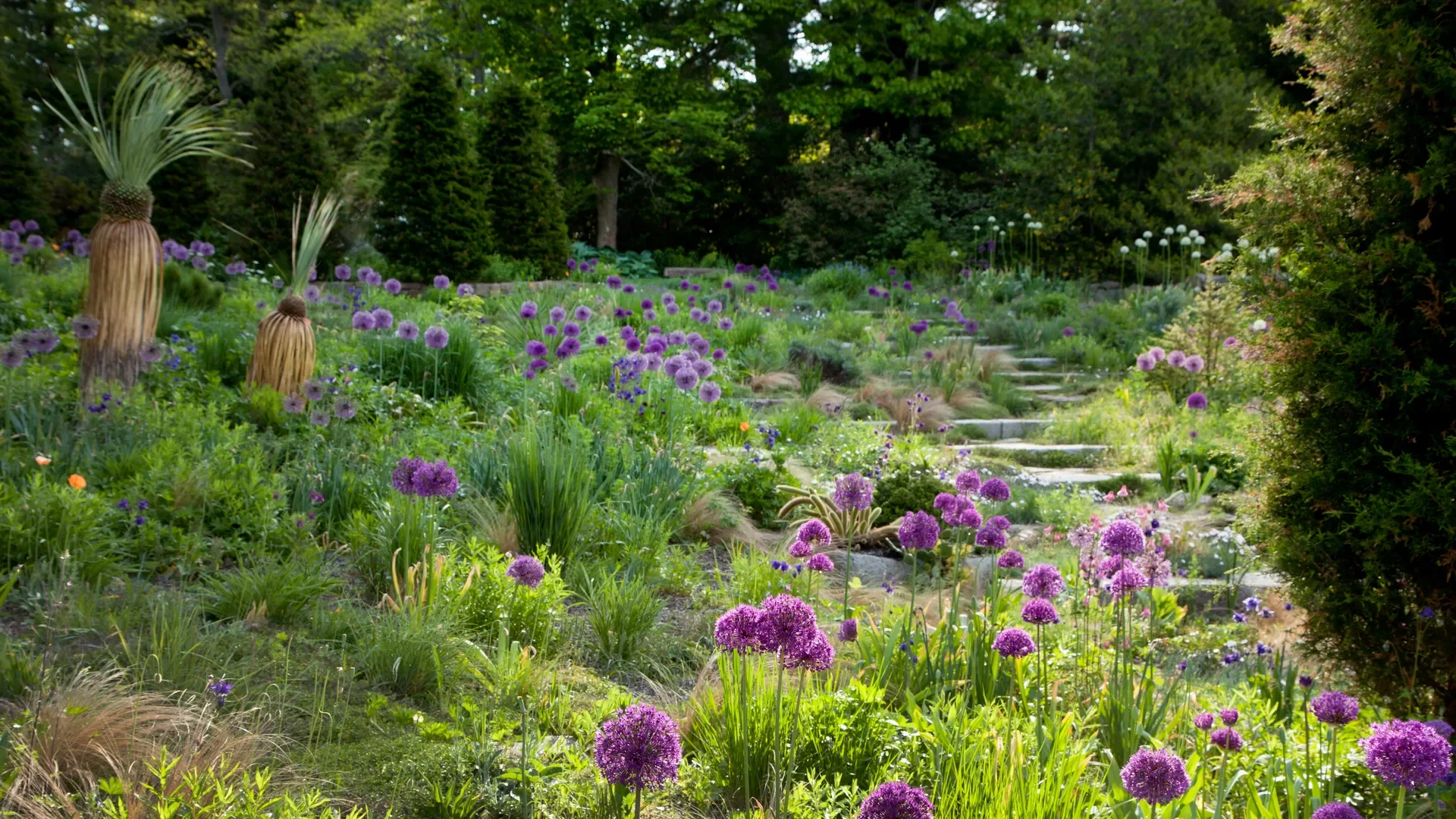
Display of alliums at Chanticleer in Wayne, PA. Architectural Digest
Allium, tulips, hyacinths (love the smell of hyacinths!) — ots of bulbs get planted in fall.
Skip the single-file row along a path or bed edge. Drifts and clusters tucked behind late-emerging perennials so the foliage has somewhere to hide as it dies back, mimic the way bulbs actually spread in nature.
This is the strategy of Piet Oudolf, the landscape designer behind New York's High Line. For bulbs specifically, he scatters and weaves them through the perennials rather than grouping them into solid blocks to get that natural, drifted look.
Top-Dress with Dark Compost or Bark
Compost, mulch, and bark all suppress weeds and also serve as insulation for roots against cold winter temperatures.
Where they differ is nutrition. Compost is fully broken-down organic matter that feeds the soil right away; bark breaks down slowly and adds little in the short term, but it holds its color and shape much longer. If you're really on your game, layer compost down first for the feeding, then finish with a layer of dark bark on top — you get the nutrition and the finished look in one pass.
One More Fast Fall Landscaping Win
None of these are complicated projects. Each one is as much a design decision as it is a garden-variety plant-care task.
If you only have time for one more thing — re-slice the edges between your beds and lawn or paths. It's a five-minute task with a sharp shovel that makes everything else on this list look finished.
Do even a few of these before the ground cools further, and both you and your garden will thank you for it come springtime.