Why Putting Rocks in the Bottom of a Pot Makes Drainage Worse (Container Soils 101)
Choosing a pot for your plant feels like an aesthetic decision - but pot shape, size, and especially potting mix directly control how much water and air your plant’s roots actually get.
And that brings us to one of the biggest misconceptions in the houseplant world:
Putting rocks (or gravel) at the bottom of a pot does not improve drainage. It makes drainage worse.
It’s an intuitive idea, and it’s been repeated forever — but container soil physics works differently than most people think. Once you understand what’s really happening in a pot after you water, you’ll be able to choose better containers, avoid accidental overwatering, and keep roots healthier long-term.
In this post, I’ll cover:
the basic science of how potting mix holds water
what a perched water table is (and why every pot has one)
why pot shape and size matter more than people realize
and exactly why the “rocks for drainage” trick backfires
Container soil science 101
How potting mix works with water in your pot
Why your plant’s pot shape & size matters
Choosing pots for plants
Container Soils 101: What potting mix is really doing
Let’s start with basic container soil science. Yep, that’s really a thing. I took an entire course devoted to container soils while at UC Davis.
In the nursery trade, potting mix is called “container media.” Most bagged potting mixes are technically soilless - meaning they aren’t made from field soil, but from blends of organic and inorganic materials designed to hold both water and air.
A good potting mix needs to:
hold sufficient water and nutrients
allow excess water to drain
maintain air space so roots can breathe
The key property behind all of this is something called matric potential.
Matric potential is simply a material’s ability to hold water within its pore spaces.
The smaller the pore spaces between particles, the more strongly water is held.
This is why:
fine-textured mixes hold more water (clay soil for example)
chunky mixes drain more freely (cacti mixes and orchid media)
Now let’s look at the forces behind that.

How water actually moves in a pot
When you water a container thoroughly, two forces are at work:
Gravity - Gravity pulls water downward through the pot causing it to move to the bottom of your pot and either sit there until it evaporates (if no drainage) or drain out.
Capillary action - Capillary action is the ability of water to move into and cling inside tiny spaces - even against gravity.
Water is “sticky.” It clings to itself (cohesion) and clings to surfaces (adhesion).
In the small pore spaces between particles, those forces are strong enough to hold water in place.
If you’ve ever dipped the edge of a paper towel into water and watched it creep upward, that’s capillary action.
The smaller the pore spaces in a potting mix, the stronger that capillary pull, and the higher the matric potential.
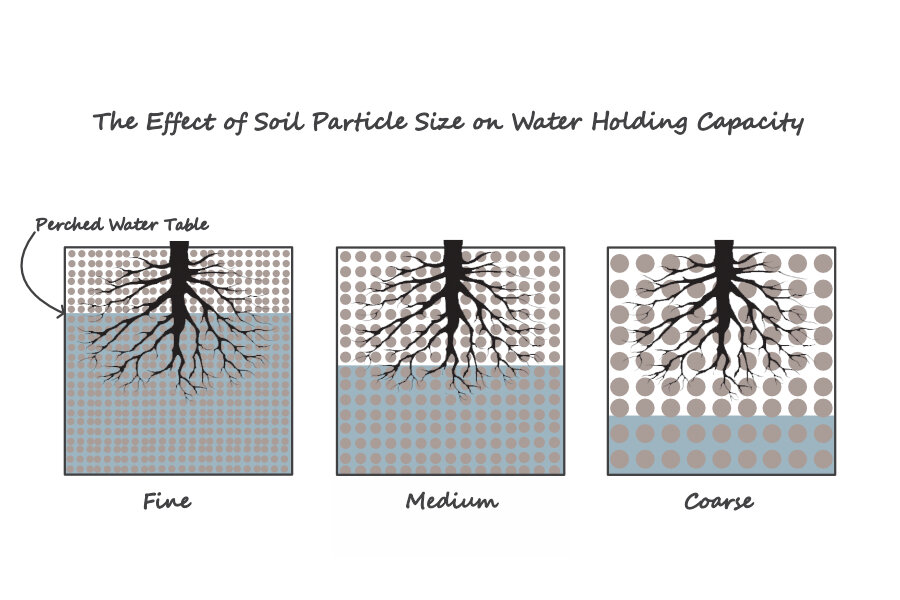
The water saturation level (aka “perched water table”) of a pot is determined by the particle sizes of a potting mix or soil. Graphic: Greenhouse Studio
What happens after you water
Even though the potting mix is uniform throughout the container, water does not distribute evenly.
Gravity pulls water down.
Capillary action holds water in the pore spaces.
Near the bottom of the pot, gravity is no longer strong enough to overcome the capillary forces holding water in the mix.
So a layer of saturation forms at the bottom.
This layer is called a perched water table.
What is a perched water table?
A perched water table is the zone at the bottom of a container that remains saturated after watering.
Here’s the key principle:
For a given potting mix, the perched water table forms at roughly the same height — regardless of container size.
It is controlled primarily by particle size (and therefore matric potential), not pot height.
Fine mixes = higher perched water table
Chunky mixes = lower perched water table
Every pot has one.
Now we can talk about rocks.

Gravity & Capillary Action: capillary action will pull water up from a certain point, and below that point, gravity keeps the water from moving up. It’s basically chemistry vs. physics. Graphic: Greenhouse Studio
Why rocks at the bottom of a pot make drainage worse
Here’s the myth:
Add gravel at the bottom of a pot to improve drainage.
Here’s what actually happens:
Water does not move easily from fine-textured material (potting mix) into coarse material (rocks).
Because of capillary forces and matric potential, water stays in the small pores of the potting mix until that mix becomes fully saturated.
Only then will it move into the larger air spaces in the gravel layer.
Instead of draining better, the pot develops a saturated zone above the rocks.
That means:
The perched water table is effectively raised
The usable soil volume is reduced
Roots sit in a wetter environment
You don’t improve drainage.
You move the wettest zone closer to the roots.
Why Container Height Matters
Because the perched water table forms at roughly the same height for a given mix, container height affects how much of the pot stays wet.
A short, wide container has the same perched water table height — but that saturated layer takes up a larger percentage of the total volume.
A taller container has more unsaturated soil above that wet layer.
So with identical potting mix:
Shorter pots stay wetter overall
Taller pots have a greater air-to-water ratio
This is why height can influence drainage behavior — but rocks do not.
What Actually Improves Drainage
Drainage in containers is controlled by:
particle size in the potting mix
container height
drainage holes
If you want better drainage:
use a chunkier mix (add pumice, perlite, bark, etc.)
choose a taller container
make sure the pot has proper drainage holes
Do not add a “drainage layer.”
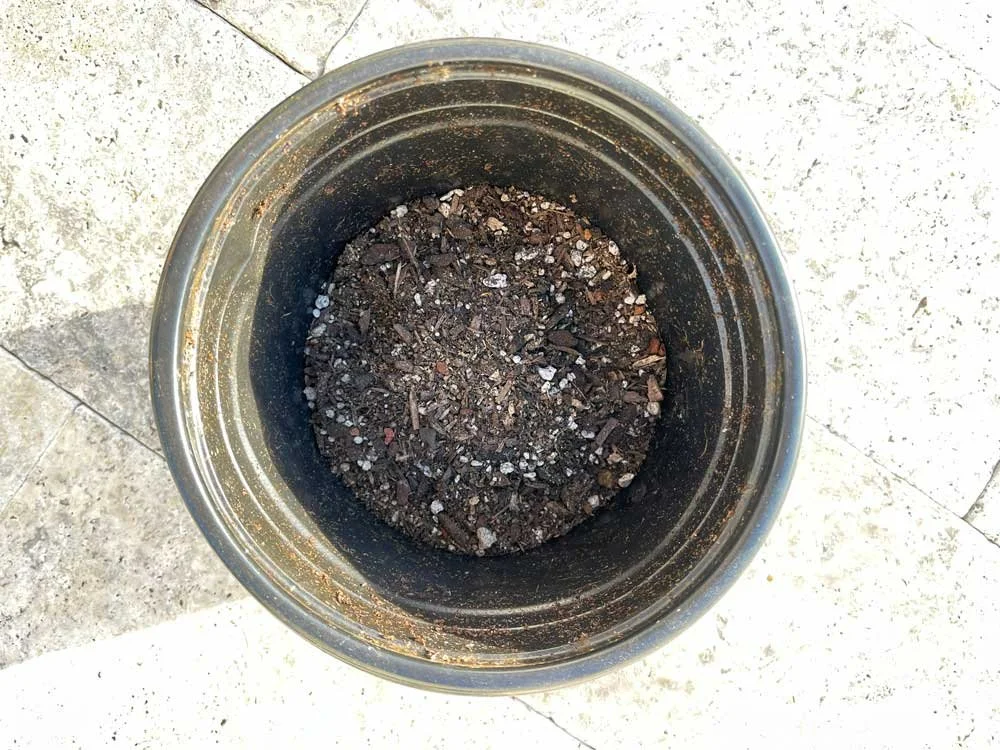
Rocks at the bottom of pots do not help drainage; they hurt drainage. The only thing you should see at the bottom of your pot is potting soil.
Why Size Matters
For a given potting mix, the perched water table is the SAME regardless of the size and height of your pot.
A container that is shallow and wide will hold water closer to the plant’s roots than one that holds the same volume but is taller.
Why?
Gravity pulls water down through the container and out of the drainage holes.
Container height affects the relative amount of water versus air. With identical potting mix, the perched water table occurs at the same height, regardless of a planter’s size. So ALL pots with the same potting mix will have identical perched water tables.
Planter shape
Given the same volumes and potting media, short pots will have the same perched water table as tall pots, so a greater percentage of container volume is filled with water in a shorter, wider pot.
This means a tall 5-gallon container holds less water than a short and wide 5-gallon container.
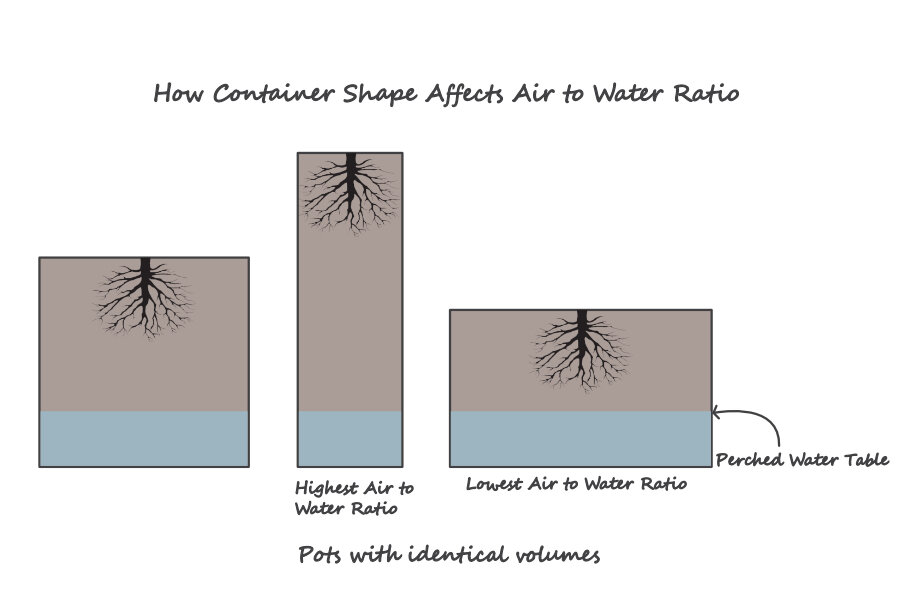
These planters are identical in volume, and given the same potting mix, all have the same perched water table. Graphic: Greenhouse Studio
Planter size
It’s the same concept with pot size:
With identical soil, the height of the perched water table in a small planter will be the same as a larger pot, therefore the ratio of water to air is highest in the largest pot.
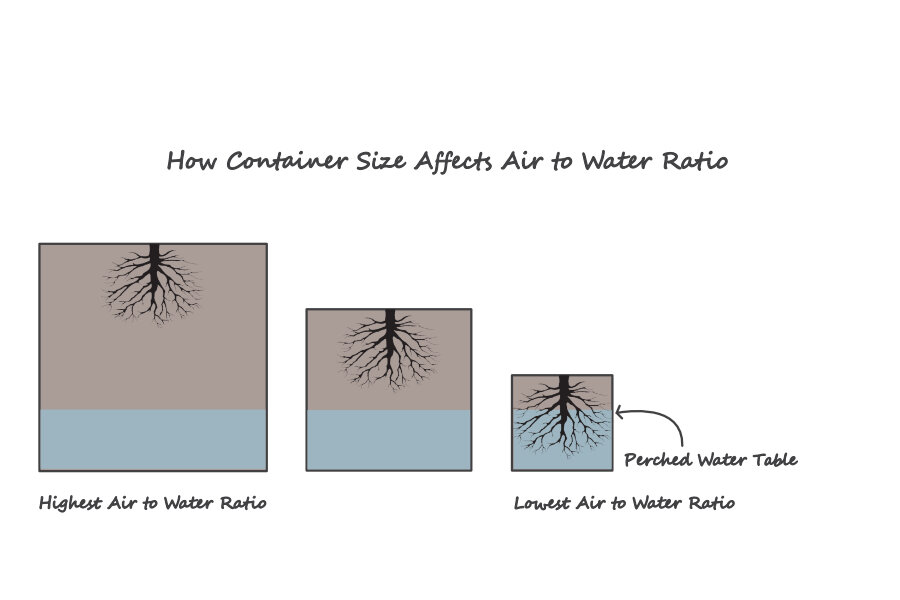
These planters are all different sizes, and given the same potting mix, all have the same level of saturation (perched water table). This means the largest pot on the left has the highest air:water ratio. Graphic: Greenhouse Studio
Bottom Line
Every container has a perched water table.
Particle size determines how high that saturated layer sits.
Matric potential explains why fine mixes hold more water.
Container height changes how much of the pot stays wet.
Rocks at the bottom raise the saturated zone into the root area instead of solving it.
The drainage myth persists because it feels intuitive, but container soil physics don’t run on intuition. It runs on pore size and capillary forces.

Sources
Graphics and information adapted from Management of Container Media by Richard Evans, Ph.D., UC Davis, for the course ENH 120.
Was this post helpful? Pin it for later!