Garden Design Ideas: How to Pick the Right Ideas for Your Space
When people search for “garden design ideas,” they’re often looking for inspiration.
Often that inspiration comes from images online, a garden feature you admire, or a garden space that simply “speaks” to you.
And inspiration absolutely matters.
Collecting images and noticing patterns in what you’re drawn to - including building a mood board - can be a powerful way to clarify your preferences.
But inspiration alone isn’t design. If you want a broader overview of how garden design actually works, start here.
An idea only becomes strong when it works with your space - the size, conditions, the house, and how you actually live in the space.
Without evaluating scale, circulation, and structure, even beautiful ideas can feel awkward once built.
In this guide, you’ll learn how to develop ideas thoughtfully — and how to evaluate whether they truly belong in your outdoor space.
TL;DR: How to Pick the Right Garden Design Ideas
Not every garden design idea will work in your space.
Before adding something new, ask:
Does it work with my site conditions?
Will I actually use it?
Will it feel comfortable at full size?
Does it get in the way of movement?
Can I build and maintain it well?
Strong ideas aren’t copied from photos.
They fit your yard, your home, and how you live.
What a Garden Design Idea Actually Is
An Idea Solves a Specific Problem
A garden design idea happens because something isn’t working.
Sometimes that problem is functional:
There’s nowhere comfortable to sit.
The patio feels exposed.
The yard lacks a clear path from door to gate.
Sometimes the problem is visual:
There’s no focal point.
It only looks attractive for a couple of seasons out of the year.
It feels piecemeal and chaotic overall.
Strong, lasting ideas are tied to a clear purpose — either functional or visual.
Being able to name that purpose helps you evaluate whether the idea fits your garden.
An Idea Is a Programming Decision
In landscape design, programming simply means deciding what happens where.
Before you choose any materials or plants, you decide how the space will be used.
Where should seating or dining go?
Where do children play?
How will people move throughout the space?
Where will vegetables be grown?
Programming answers questions about use.
It’s the stage where you organize activities in the yard in a way that makes sense.
For example:
A seating area belongs close to the house living area access
Dining belongs near the kitchen for convenience.
Play space belongs where it’s visible from inside.
A tree is planted or shade structure built where shade is needed.
Those decisions shape layout, circulation, size, and placement. This is where garden layout begins to take shape.
Once programming is clear, the rest of the design becomes much easier to create and evaluate.
Features Support the Idea — They Are Not the Idea
A feature is the physical thing.
An idea is the purpose it serves.
For example:
A fire pit is not the idea. Creating a central gathering space is.
A row of hedges is not the idea. Defining the edge of an outdoor room is.
A specimen tree is not the idea. Providing shade where people sit is.
A fountain is not the idea. Creating a focal point that anchors a view is.
The object is visible. The idea explains why it belongs there.
However, sometimes the purpose is primarily visual. For example:
A tall, narrow tree placed at the end of a long path may exist to strengthen a view. Layered planting along a blank fence may exist to soften a hard boundary.
So even aesthetic decisions serve a role.
When a feature is chosen because it supports how the space functions or feels, it becomes part of the design - not just a random addition.
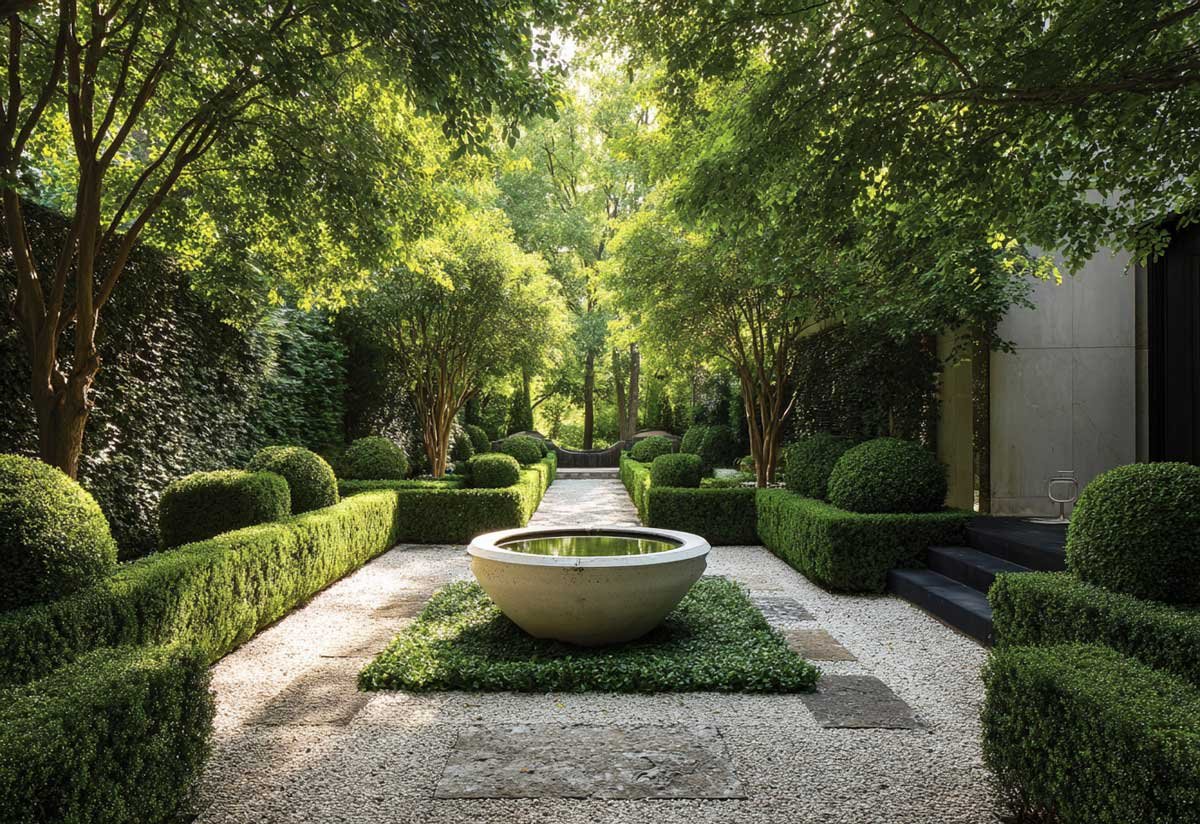
The fountain is the feature that supports the idea of creating a focal point at the garden axis.
Where Strong Design Ideas Come From
Strong ideas rarely appear out of nowhere. They emerge from real site conditions.
Start With Your Site’s Constraints and Opportunities
In landscape design, a constraint is an existing condition that influences your decisions.
An opportunity is an existing condition that can be leveraged.
Designers often begin a project with a simple site analysis. This kind of evaluation is part of thoughtful garden planning.
From the site analysis, they will create a list titled: Site Constraints and Opportunities
This isn’t complicated. It’s simply a way of understanding and evaluating the property’s existing conditions.
Constraints might include:
Property lines
The location of the house and doors
Slopes or grade changes
Drainage patterns
Utilities
Limited access points
Opportunities might include:
A beautiful view outward
A mature tree worth preserving
A natural level area near the kitchen or living area
A sunny corner suitable for planting vegetables
A blank wall that could anchor a focal point
Listing your site’s constraints and opportunities reveals where effort will be required - and where the site is already helping you.
For example: A mature tree near the house can create immediate, usable shade. That makes it an opportunity for:
Locating a seating area beneath it
Reducing the need for a built shade structure
Cooling a patio during summer months
Instead of planning a pergola from scratch that would cost thousands, the tree becomes the shade structure.
Another example: If there’s a significant slope, that affects where level gathering areas will be created - and/or where steps or retaining walls may be required.
When constraints and opportunities guide your planning, your garden design ideas are built on a solid foundation.
This shifts your thinking from adding features to responding to the site.
Bringing Inspiration Back In
Once you’ve assessed your site and clarified how the space needs to function, you can return to your inspiration sources like your garden design mood board with a new filter and focus.
At this stage, you’re no longer collecting ideas at random.
You’re looking for ideas that could work in your conditions — and you’re able to tell the difference.
This is where inspiration becomes useful: not as a template to copy, but as a source of possibilities you can test.
How to Evaluate Whether an Idea Fits Your Garden
Finding garden design ideas is easy. Deciding which ones belong in your yard is harder.
Many homeowners collect dozens of garden design ideas before ever stepping outside. Evaluating those ideas against your site conditions is what turns inspiration into real design.
A useful evaluation method should help you answer one question:
Does this idea make my garden stronger?
Use the following checks to evaluate whether something truly fits.
1) Will this garden design idea work with my existing conditions?
Start with your Site Constraints and Opportunities list.
Ask:
Does this idea work with my sun/shade patterns?
Does it respect existing trees?
Does it account for slope or drainage?
Does it take advantage of a view — or block one?
Does it require major site correction to function?
For example:
If a seating area will sit in full west sun without shade, it may be uncomfortable most of the year.
If a path runs through a low, wet area, it may require drainage correction to succeed.
You don’t have to eliminate every challenge — but you should understand what adjustments will be required.
Ideas that fight the site often demand ongoing correction - which is both expensive and time consuming.
Ideas that work with your site will stand the test of time.
2) Will I actually use this?
This is where your programming decisions start working for you.
Ask:
What activity is this idea supporting?
How often will it be used?
Who is it for?
Is it practical in terms of budget, site, maintenance?
A fire pit isn’t automatically a good idea. A gathering area that supports how you actually entertain might be.
A water feature isn’t automatically a good idea. A focal point placed where you’ll actually see it and enjoy it while also helping to block road noise might be.
If an idea doesn’t support how you actually live and use your space, it probably doesn't belong, and you can allocate budget and effort elsewhere.
3) Will this idea feel comfortable at full scale?
This is where you test scale in practical terms. For your own garden, you can - and you should.
That might mean:
Marking the edges of a proposed patio with spray paint or rope
Setting out chairs where a seating area would go
Measure and walk the proposed path width
Study your sun and shade patterns
Stand in it.
Walk through it.
Sit in it.
Can people move around comfortably?
Is there room to to push back chairs around a dining table?
Does the area feel cramped? Oversized? Balanced?
Seeing and standing in the proposed space reveals problems quickly.
A sketch can look ‘correct’ but staking out a space can quickly confirm or refute what’s on paper.
So test at full size to mitigate surprises.
4) Does it respect movement patterns?
Most yards have natural movement patterns already.
People head straight to gates, trash bins, side doors, seating, gardens, and play areas.
Ask:
Does this idea block a natural route?
Does it create an awkward detour?
Will people step through planting to bypass it?
If an idea disrupts natural flow and movement, it becomes a daily annoyance, even if it looks great in a photo or on paper.
6) Will this garden design idea stand the test of time?
Finally, evaluate the long term.
Ask:
Does the budget support doing this properly?
Can it be maintained consistently?
What will the mature size of the plants be as they grow over time?
Will it still function and look good in five years?
Some ideas require precise maintenance to look good (think concrete that can stain and crack and elaborately trimmed hedges and topiary).
Others are more forgiving (pea gravel and plants that are pruned minimally).
Honestly considering the maintenance required helps prevent future frustration.
A Practical Evaluation Order
If you’re unsure whether an idea belongs in your garden, run it through this sequence in order. Each step builds on the one before it.
Does it work with my site conditions?
Sun, slope, drainage, existing trees, and access points come first.
If it fights the site, it will require correction.Does it support how I actually use the space?
Can you clearly describe when and how it will be used?
If not, reconsider.Will it feel comfortable at full size?
Mark the footprint. Walk it. Sit in it.
If it feels cramped or oversized, adjust before building.Does it respect movement patterns?
Does it block natural paths or create awkward detours?
If circulation suffers, the idea likely needs revision.Can I build and maintain it well?
Budget and long-term upkeep matter.
If maintenance becomes a burden, the design, and your user experience, will suffer.
You don’t need to overanalyze every idea. But if something struggles at multiple stages in this sequence, it’s usually a signal.
Ideas that hold up through all 5 checks will likely be successful in your garden space and you can enjoy them for years to come.
Moving From Idea to Action
Once an idea passes your evaluation sequence, give it a “test drive” before committing.
Sketch it roughly to scale.
Mark the footprint on the ground.
Walk through it.
Adjust before building.
Small changes at this stage are easy. After installation, they are expensive.
Resolve the major decisions - space, movement, structure - before focusing on materials and details.
When the underlying decisions are solid, the finishing touches tend to fall into place naturally.
Strong Ideas Create Successful Gardens
A cohesive garden isn’t created by collecting more ideas. It’s built by choosing the right ones.
When ideas:
respond to real site conditions
support how you live
feel comfortable at scale
respect movement
and hold up over time
…the result is a garden that feels intentional — because it fits. If you’d like guided support applying this process step-by-step, you can learn more about learning garden design here.
And while you can absolutely begin thinking this way on your own, many gardeners find that having structured guidance makes the process smoother and more enjoyable.