Learn Garden Design (A Practical Approach for Gardeners)
Most gardeners don’t start with a clear vision for their garden. They may have a treasure trove of stockpiled Pinterest images, or they may not yet have a vision at all — they just know that the space they have now isn’t the one they want.
Regardless, they share a common problem: they’re not sure how to make it better.
Ideas alone don’t solve that problem. Even when you’re drawn to certain styles, plants, or layouts, translating those preferences into a real garden is rarely straightforward. Every space has its own constraints — size, light, circulation, existing features — and those conditions shape what will actually work.
This is where many gardeners get stuck. They make changes one at a time, hoping the next choice will be the one that pulls everything together. Sometimes it helps. Often it doesn’t. And it’s not because the ideas are bad — it’s because the decisions aren’t connected.
Learning garden design gives you a way to connect those decisions - instead of treating each one as a separate fix.
It helps you understand how a garden functions as a whole, how different elements relate to each other, and how to move forward with intention instead of guesswork. Not by copying a finished look, but by learning how gardens are planned, shaped, and refined over time — so your choices about layout, structure, and planting support each other instead of competing.
This page is for DIY gardeners and homeowners who want to learn garden design as a skill, not just decorate a yard or patio and hope it holds together season after season.
If you’ve ever thought, “I know what I like, but I don’t know how to make it work,” you’re in the right place.
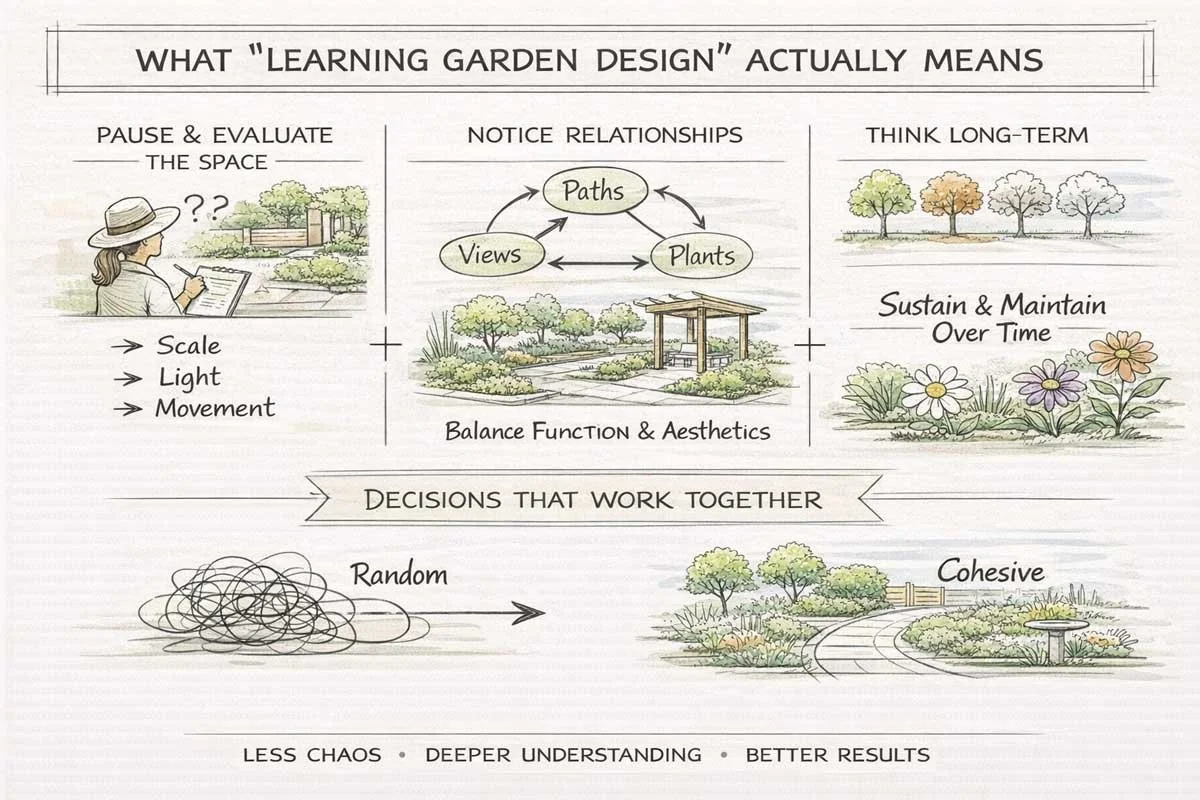
What “learning garden design” actually means
Learning garden design isn’t about mastering a set of rules or developing a special eye overnight. It’s about taking small but deliberate steps toward learning how to evaluate a space and make decisions that work together instead of fighting each other.
In practical terms, learning garden design means learning how to pause before you act - to evaluate the space, notice relationships between elements, and consider how today’s decisions will hold up over time.
Instead of reacting to isolated issues, you begin weighing function, maintenance, and aesthetics together.
Understanding what garden design actually is gives you a way to evaluate a space before making expensive and time-consuming changes. You’ll notice things like scale, repetition, spacing, and how people move through the site.
You’re no longer guessing or reacting to problems one at a time. Instead of choosing plants and random paving materials in isolation for instance, you begin to see how individual decisions affect the garden as a whole - either positively or negatively.
And for sure - throwing random seeds and plants into the ground and praying it all somehow ‘comes together’ will be a thing of the past.
Your choices will now reinforce each other, so your garden gradually feels more cohesive, functional, and settled.
This while this may sound intimidating at first, with a bit of practice, it will naturally change how you think, how you work, and how you perceive gardening as a whole.
And rest assured, design is just a system of thinking that can be learned by anyone.
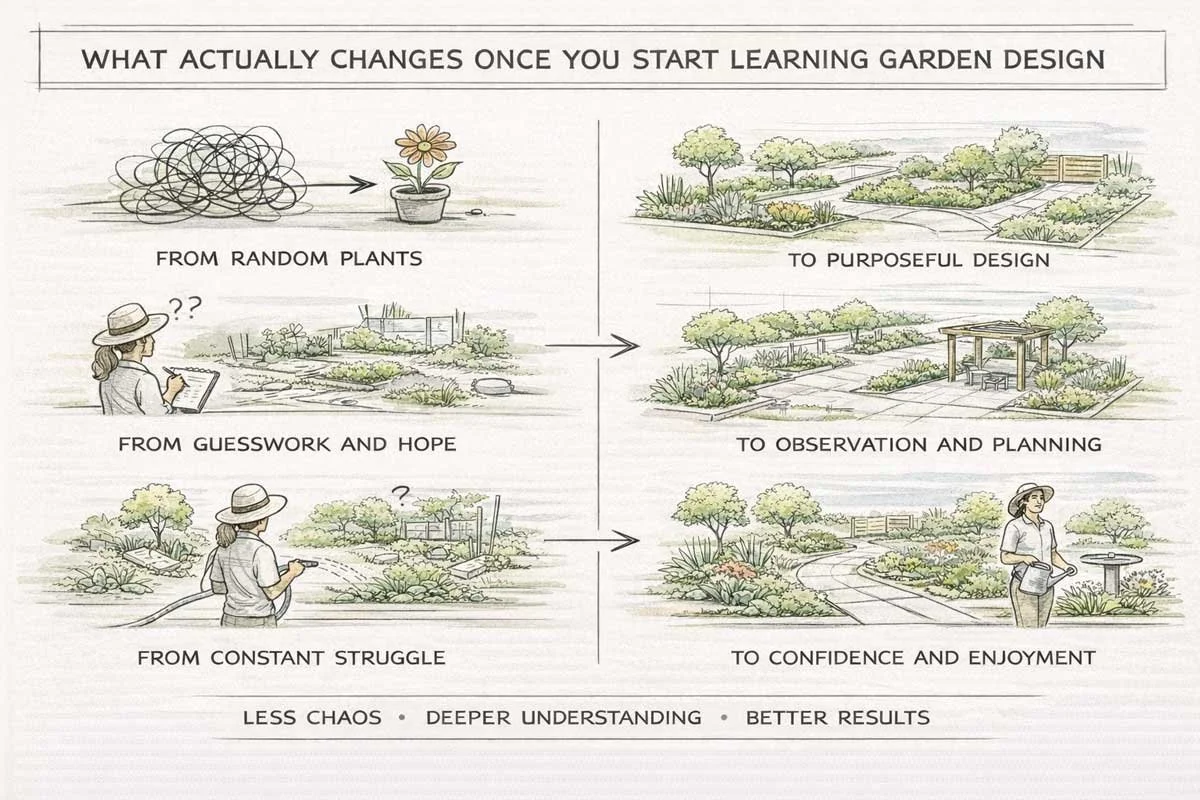
What actually changes once you start learning garden design
Learning garden design doesn’t suddenly give you a perfect plan or eliminate trial and error. What it does change is how you approach decisions, and that shift alone makes a noticeable difference.
Instead of asking, “What should I add here?” you start asking, “What is this area supposed to do?”
That change slows you down in a good way. It helps you stop reacting to isolated problems and start thinking about the space as a whole.
You begin to notice patterns that were easy to overlook before.
Areas that feel cluttered often aren’t necessarily overplanted - often they’re missing repetition and massing. Areas that feel empty may not need more variety, but clearer structure. You start seeing why one part of the garden feels calm while another feels unsettled.
Shopping for plants changes, too. Rather than buying whatever catches your eye and hoping it works out later, you start evaluating whether a plant supports the overall layout and rhythm of the space. You may buy fewer plants — but the ones you choose tend to work harder.
Most importantly, you gain a way to decide what to focus on first.
Instead of trying to fix everything at once, you can identify one area where changes will have the biggest impact. That makes progress feel manageable instead of overwhelming.
These shifts may sound subtle, but they compound. Over time, your garden starts to feel more cohesive — not because every choice is perfect, but because the choices now relate to each other.
That’s the practical outcome of learning garden design:
Fewer disconnected decisions, clearer priorities, and a growing sense that you understand why your garden is working - or why it isn’t - and what to do next.
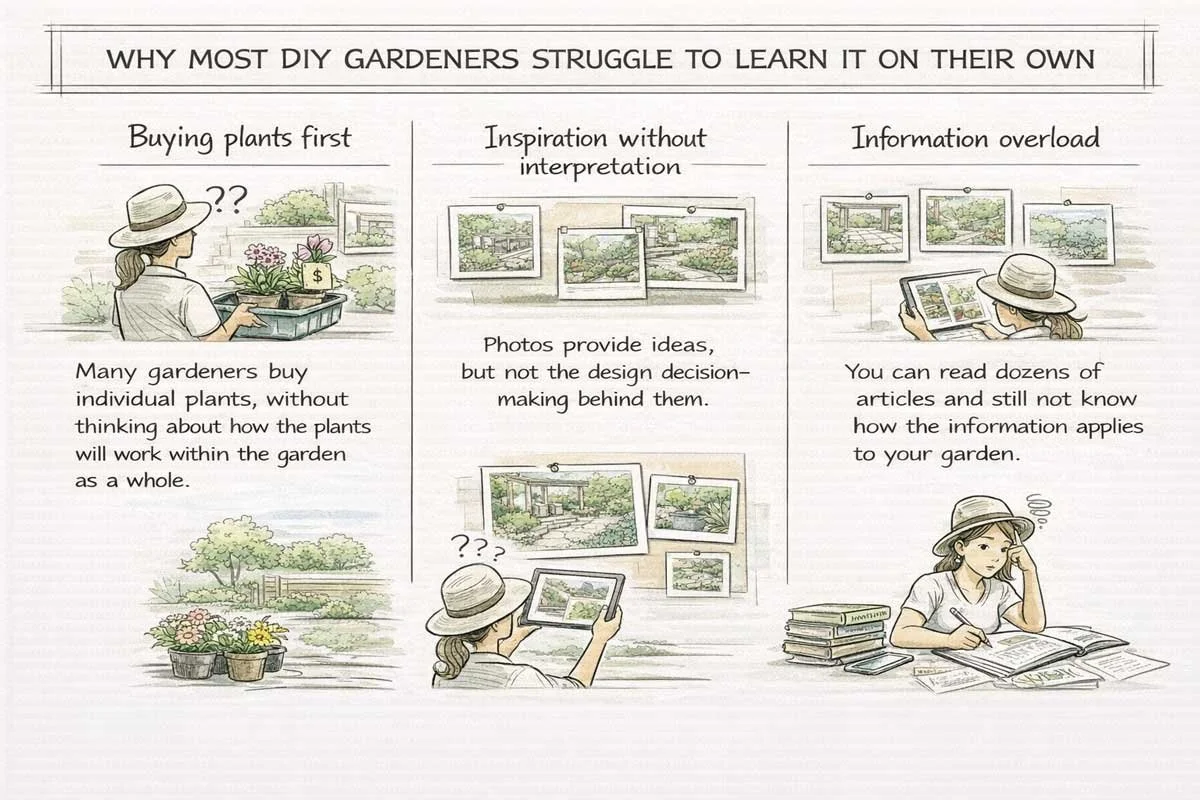
Why most DIY gardeners struggle to learn it on their own
Most people don’t struggle at garden design because they lack effort - quite the opposite. However, they struggle because garden design isn’t intuitive when you’re trying to figure it out piece by piece, in real time, on your own property.
Maybe a bed looks sparse, so you add more plants. Maybe an area feels cluttered, so you pull things out. Each change makes sense on its own - but the garden still doesn’t come together.
So often I see gardens full of healthy plants, but the space still doesn't feel good to be in because design factors like circulation, repetition, spacing etc. were never considered together.
Individual fixes don’t address how the space works as a whole.
Other common patterns I see again and again:
Starting with plants instead of garden structure.
Many gardeners focus on buying individual plants, without thinking about how the plants will work together.
Inspiration without interpretation.
Photos provide ideas, but not the design decision-making behind them, which is what actually teaches design.
Information overload.
You can read dozens of articles and still not know why your own garden isn’t working.
Learning garden design without a framework often leads to a frustrating cycle of trial-and-error fatigue — not confidence.
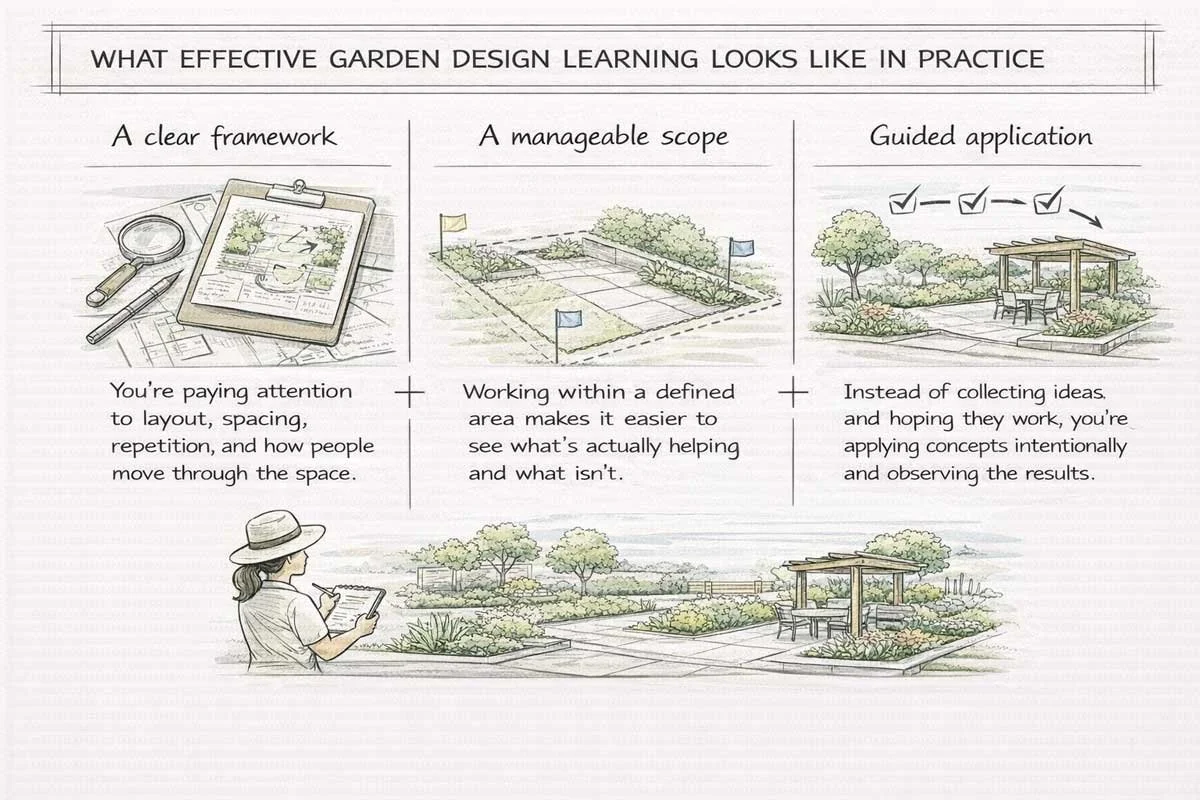
What effective garden design learning looks like in practice
Real learning happens when theory and practice are paired. The simplest way to start is by evaluating one small area — not to redesign it right away, but to understand how its parts relate.
When learning is approached this way, a few key conditions are in place:
A clear framework.
You’re not guessing what to look for. You’re paying attention to layout, spacing, repetition, and how people move through the space.A manageable scope.
Working within a defined area makes it easier to see what’s actually helping and what isn’t - without the overwhelm of solving the entire garden.Guided application.
This is key: Instead of collecting ideas and hoping they work, you’re applying concepts intentionally and observing the results with someone looking over your shoulder acting as a guide.
By working through a single, limited space, you can focus on layout, structure, plant relationships, and visual logic — and then apply that thinking elsewhere.
Seeing how decisions hold up across different seasons in one defined area builds your understanding and therefore your skills.
The outcome isn’t just a finished space.
It’s understanding why it works — and how to recreate that result in another context.
That’s how design skills becomes transferable.
Who learning garden design works best for
Learning garden design in a structured way is a good fit if you:
Want to understand the “why” behind what you’re doing, not just follow instructions
Prefer clear reasoning over vague inspiration
Care about long-term results, year-round seasonal interest, and long-term maintainability
Want to be able to make design decisions in more than one scenario
Enjoy learning through doing
It’s especially valuable if you want to be less dependent on constant outside input —
Whether that’s hiring an expensive landscape designer or relying on often questionable advice from garden influencers (if I hear one more ‘garden expert’ talk about how putting rocks in containers improves drainage…), garden centers (they're great at horticulture, not design), or Pinterest boards (great for inspiration, not implementation).
When learning garden design probably isn’t the right fit
Structured learning may not be a fit if you’re looking for:
A quick makeover without learning process (installing a bed of annual flowers that last for a season)
A shopping list of individual plants (like a plant collector might do)
A purely decorative approach that doesn’t consider site and climate (e.g. an English cottage garden with lots of lawn in Phoenix.)
Those approaches can have their place. They just don’t teach design.
A note on how I teach garden design
I come to this work with degrees in landscape architecture and horticulture, alongside years of real-world garden design experience and teaching, including authoring a course for LinkedIn Learning.
What I’ve learned — both in practice and education — is that people don’t need more inspiration.
They need clear thinking tools and a way to practice them without overwhelm.
Garden design becomes much more accessible when it’s taught the way designers actually learn: through structure, constraints, and repetition.
This teaching philosophy informs everything you’ll find here at Greenhouse Studio.

A LinkedIn Learning instructor’s reunion at LinkedIn headquarters in San Francisco, California.
Where to go next
If you’re serious about learning garden design — not just fixing one space — these are the most useful next steps:
Explore garden planning fundamentals to understand how decisions are made before plants ever come into play.
Work through diagnostic content that helps you identify why a space feels off, not just what to change.
If you’re interested in deeper, guided learning, a comprehensive garden design course is in development and will be introduced here when it’s ready.
You don’t need to rush.
Learning garden design is cumulative — and the clarity compounds.
If you’re willing to learn the thinking behind the work, you’ll never look at your garden the same way again.
Start with a Garden Audit
If you’re not sure why your garden feels off — or where to focus first — the most useful next step isn’t more ideas. It’s diagnosis.
I’ve created a free Garden Audit to help you evaluate your space the way a designer does.
It walks you through the core elements that determine whether a garden works — layout, structure, plant relationships, and function — so you can pinpoint what’s helping your garden and what’s quietly working against it.
Most people discover they don’t need to redo everything.
They just need to fix the right thing first.
The audit takes about ten minutes, requires no design background, and gives you a clear starting point — whether you’re planning changes now or later.